

Hollow Knight: Silksong in 2026 – Hardest Bosses, Combat Mechanics and Walkthrough Tips
Hollow Knight: Silksong remains one of the most demanding action-adventure games in 2026, combining precise combat, challenging boss encounters and an enormous interconnected kingdom. Released on 4 September 2025, Team Cherry’s sequel follows Hornet as she travels through Pharloom, a mysterious land filled with dangerous creatures, hidden passages and powerful enemies. Unlike the original Hollow Knight, Silksong places greater emphasis on aerial movement, aggressive fighting and adapting to different combat situations. Some bosses require excellent timing, while others test positioning, patience and the ability to recognise complicated attack patterns. Understanding Hornet’s abilities, choosing appropriate equipment and exploring each region thoroughly can make difficult encounters considerably more manageable. This guide examines the toughest bosses, explains the essential combat mechanics and offers practical advice for progressing through the game in 2026. Be aware that the following sections contain boss and late-game spoilers.
The Hardest Bosses in Hollow Knight: Silksong
Silksong features numerous challenging encounters throughout its three acts, although difficulty varies considerably depending on the player’s equipment, experience and preferred fighting style. The first major obstacles appear relatively early, with enemies such as Widow and the Last Judge demanding greater precision than most ordinary opponents. Later encounters become more elaborate, introducing faster combinations, environmental hazards and attacks that cover large sections of the arena. Optional bosses can be particularly punishing because they often expect players to have mastered abilities acquired during earlier exploration. There is no universally accepted difficulty ranking, but Lost Lace, First Sinner, the Last Judge and several late-game opponents are frequently identified among the game’s most demanding fights.
The Last Judge is one of the most significant difficulty increases during Act 1. Encountered at the Grand Gate, this imposing opponent uses a massive bell attached to a chain, combining sweeping attacks with sudden charges and powerful ground strikes. During the opening phase, maintaining a suitable distance makes the bell’s movements easier to anticipate. The second phase introduces fire, turning previously manageable attacks into dangerous combinations of direct strikes and spreading flames. Jumping over the resulting shockwaves is generally safer than attempting to retreat along the ground. Players should also remember that defeating the Last Judge does not immediately remove every danger: the boss produces a final explosion, making a quick retreat essential.
Widow presents a different challenge near Bellhart, relying on rapid movement and falling bells to control the available space. Her attacks can force Hornet into uncomfortable positions, particularly when several hazards appear in quick succession. Instead of constantly chasing the boss, it is better to watch where the bells will land and move towards an open section of the arena. The Cogwork Dancers, encountered later in the Cogwork Core, demand another approach. These mechanical opponents perform coordinated movements that can initially seem unpredictable. However, their attacks follow recognisable sequences, allowing careful players to identify safe positions and strike during the pauses between movements. Both encounters reward observation more reliably than continuous attacking.
Lost Lace, First Sinner and Other Difficult Encounters
Lost Lace is widely regarded as one of Silksong’s most difficult encounters and serves as a major challenge during Act 3. This confrontation builds upon Hornet’s earlier encounters with Lace, introducing relentless attacks and considerably less room for careless movement. The boss can move across the arena rapidly, forcing players to react to successive attacks rather than treating each strike as an isolated event. The safest approach involves recognising the beginning of each combination, avoiding unnecessary aerial movement and responding with only a few hits when a genuine opening appears. Attempting lengthy combinations is especially risky because Lace can quickly recover and interrupt Hornet’s attacks. Players who struggle should concentrate on surviving individual sequences before attempting to increase their damage output.
First Sinner, an optional opponent associated with the Slab, tests players through sudden repositioning and dangerous magical attacks. Its unpredictable-looking movement can encourage frantic responses, but reacting too early often leaves Hornet exposed. A more reliable strategy is to watch for the boss’s next appearance, identify the direction of the incoming attack and preserve enough space to evade it. Skarrsinger Karmelita, encountered during Act 3 in the Far Fields, represents another substantial challenge. The confrontation combines demanding combat with enemy waves, making resource management particularly important. Entering these encounters with suitable defensive tools and a reliable method of generating Silk can improve consistency, although learning the attack patterns remains the decisive factor.
Grand Mother Silk and the second major confrontation with Lace also deserve attention because they occur during an important stage of the story. Grand Mother Silk challenges players with changing arena hazards, creating situations where positioning matters as much as offensive accuracy. Meanwhile, the later Lace encounter places greater emphasis on anticipating counterattacks and recognising the difference between a genuine opening and a dangerous interruption. Players do not need to defeat every optional boss to make progress, but exploring additional areas can provide useful upgrades before returning to difficult fights. When repeated attempts become frustrating, collecting more equipment, improving the Needle or practising against less demanding opponents can produce better results than immediately restarting the same battle.
Combat Mechanics and Essential Abilities in Silksong
Hornet’s combat system differs substantially from that of the Knight in the original Hollow Knight. Her Needle supports rapid attacks and precise movement, while many of her abilities encourage a more active approach to fighting. She can attack opponents from multiple directions, move quickly between positions and combine offensive actions with aerial manoeuvres. However, speed alone does not guarantee success. The direction of an attack can change Hornet’s position, particularly when striking downwards, making it important to understand where she will land afterwards. Against bosses with complicated movement patterns, a carefully timed single attack can be more valuable than an extended sequence that leaves her unable to dodge.
Silk is central to both survival and offensive combat. Hornet collects this resource by striking enemies and can spend it on healing or specialised Silk Skills. Her basic Bind ability consumes nine strands of Silk and restores three Masks of health, provided the action is completed without interruption. Unlike the healing system in the original game, Bind can also be performed in the air, creating additional opportunities during encounters with ground-based attacks. However, healing still requires sufficient time, and an interruption can waste the collected Silk. Players should therefore avoid attempting Bind immediately after receiving damage. Waiting until a boss completes a lengthy movement or becomes temporarily vulnerable is usually a more dependable option.
Silk Skills introduce additional ways to handle difficult encounters, allowing Hornet to use specialised attacks rather than relying entirely on her Needle. These abilities can be particularly helpful when a boss is difficult to approach safely or when several enemies occupy the same area. Cross Stitch, for example, provides a counterattack-focused option that rewards accurate timing. Other skills offer different offensive possibilities, making experimentation worthwhile as additional abilities become available. Nevertheless, spending Silk aggressively creates a trade-off: the resource used for an attack cannot simultaneously be reserved for healing. During unfamiliar boss fights, keeping enough Silk available for recovery is often sensible until the encounter becomes more predictable.
Crests, Tools and Movement Techniques
Crests are among the most important elements of Silksong’s customisation system. Rather than simply providing passive bonuses, they can change Hornet’s attack patterns, influence her fighting style and determine which tools can be equipped. The Wanderer Crest favours quick strikes and close-range combat, while the Beast Crest offers broader, claw-like attacks. The Reaper Crest provides another alternative and can support Silk generation through its particular approach to combat and Binding. No single Crest is ideal for every opponent. A fast boss may be easier to manage with responsive attacks, whereas an encounter featuring larger openings may reward a more deliberate fighting style. Players should practise with a new Crest before entering an important battle, especially if it changes their familiar downward attack.
Tools provide further flexibility and are divided into different categories with distinct functions. Red tools generally offer active offensive options, including weapons and devices that can help damage enemies from a safer distance. Blue tools provide defensive or supportive effects, while yellow tools often assist with exploration and resource collection. Some offensive tools require replenishment using Shell Shards, so their availability should be checked before a demanding encounter. A defensive option such as Magma Bell can be useful when facing fire-related hazards, while equipment that improves healing or Silk management may suit longer battles. The most effective combination is not necessarily the one that produces the greatest immediate damage, but the one that allows a player to survive consistently.
Movement techniques become increasingly important as Hornet progresses through Pharloom. Swift Step improves mobility, while later abilities such as Clawline and Faydown Cloak expand the range of places she can reach. These upgrades also influence combat by providing new ways to reposition, escape attacks and navigate complicated arenas. The ability to bounce from enemies or objects using downward attacks can help maintain height, but it requires careful control because Hornet’s attack angle depends on her current Crest. Dashing should be used deliberately rather than continuously, since an unnecessary dash may leave her poorly positioned for the next attack. Learning when to remain grounded, when to jump and when to retreat is essential for surviving the more demanding encounters.
Walkthrough Tips and Progression Through Pharloom in 2026
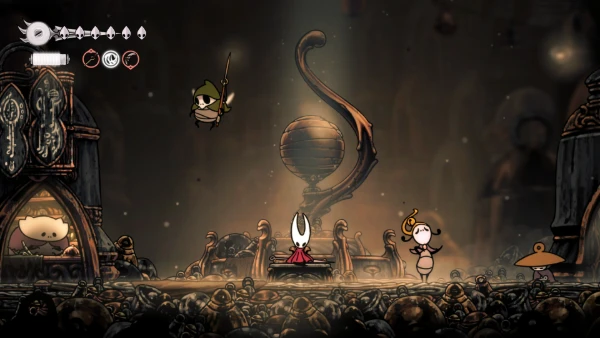
Silksong’s progression revolves around exploration, combat and gradually unlocking access to previously unreachable locations. The game begins in Moss Grotto and leads Hornet through a network of settlements, caves, industrial environments and dangerous wilderness areas. Early locations such as Bone Bottom and the Marrow introduce important systems, including merchants, maps and transportation. Defeating the Bell Beast provides access to Bellway travel, which becomes increasingly valuable as the kingdom expands. Rather than following a completely linear route, players are encouraged to revisit earlier areas after obtaining new movement abilities. Locations that initially appear inaccessible may contain useful tools, permanent upgrades or routes towards optional encounters.
Exploration becomes easier when players take advantage of maps, benches and the services offered by friendly characters. Shakra sells maps for various regions, helping players understand the connections between unfamiliar areas. Benches provide places to rest, manage equipment and prepare for the next section, although some require payment before they can be used. Rosaries serve as an important currency for purchases, while Shell Shards support the replenishment of certain tools. Because death can put collected Rosaries at risk, spending or securing valuable resources before entering a dangerous area can reduce unnecessary losses. Players should also pay attention to Wish Boards, which offer additional objectives linked to characters, settlements and exploration throughout Pharloom.
Progress through the Citadel introduces more demanding environments and increasingly complex encounters. Areas such as the Cogwork Core test precision through moving machinery, hazardous routes and coordinated enemies. Before attempting a major boss, players should identify the nearest available bench and consider whether additional exploration could improve their chances. Needle upgrades increase offensive effectiveness, while health and Silk improvements make extended encounters more manageable. It is also useful to practise movement techniques against ordinary enemies instead of learning everything during a boss fight. For players who become stuck, checking unexplored passages and unfinished Wishes is often worthwhile because Silksong regularly rewards detours with equipment or abilities that can make later challenges easier.
Act 3, Advanced Challenges and Practical Survival Strategies
Reaching Act 3 requires more than defeating the apparent final opponent of Act 2. Players pursuing this additional chapter must complete important objectives throughout Pharloom and eventually unlock the Silk and Soul Wish. This involves substantial exploration, progress with settlement-related activities and collecting the items required for the Wish. The subsequent encounter with Grand Mother Silk must also be resolved in the appropriate way to access the additional story content. Because certain opportunities and endings depend on earlier decisions, players interested in completing everything should investigate unfinished quests before advancing. Act 3 introduces further challenges and powerful enemies, including encounters that expect a strong understanding of the game’s combat systems.
Preparation is especially important before late-game encounters. A practical routine involves reaching the nearest bench, selecting a familiar Crest, checking available tools and entering with as much health and Silk as possible. During the first few attempts, concentrating on observation rather than victory can reveal valuable information about attack combinations and recovery periods. Players should identify which movements consistently cause damage and adjust their positioning accordingly. If an opponent repeatedly attacks the ground, greater use of aerial movement may help. Against fast enemies that control the air, remaining grounded and conserving the dash can be more effective. Short, controlled attacks are usually preferable until the boss’s behaviour becomes familiar.
Silksong also rewards players who approach repeated failure as an opportunity to refine their technique. Changing equipment after every defeat can make it difficult to establish a consistent strategy, so it is often better to practise a promising setup for several attempts before making adjustments. Watching the opponent rather than focusing entirely on Hornet helps with recognising incoming attacks, while avoiding unnecessary movement preserves options for emergencies. Difficult encounters such as Lost Lace demand patience, but they become more manageable when individual attack sequences are understood. By 2026, Silksong offers a substantial adventure with demanding optional challenges, varied fighting styles and plenty of reasons to revisit Pharloom. Successful progression ultimately depends less on perfect reflexes than on learning how the game’s movement, resources and enemy behaviour work together.
Similar articles
-
Hollow Knight: Silksong in 2026 ...
Hollow Knight: Silksong remains one of the most …
-
 Why Slots Look More Like Video G...
Slot machines once relied on spinning reels, fruit …