
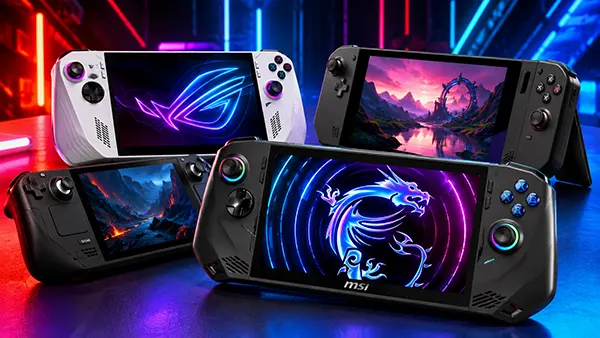
Portable Gaming PCs in 2026: MSI Claw 8 AI+, Intel Arc G3 and the New Competition for Steam Deck
Portable gaming PCs have moved far beyond being niche devices for enthusiasts. Since the arrival of Valve’s Steam Deck, manufacturers have invested heavily in more powerful hardware, higher refresh-rate displays, improved battery technology and advanced AI-assisted graphics solutions. By June 2026, the market is more competitive than ever, with MSI, ASUS, Lenovo and Valve all pursuing different approaches to handheld gaming. Among the most discussed developments are MSI’s Claw 8 AI+, Intel’s Arc G3 graphics architecture and the growing pressure placed on Steam Deck by a new generation of Windows-based gaming systems.
How Portable Gaming PCs Have Changed Since Steam Deck
When Steam Deck entered the market, it demonstrated that modern PC games could be played comfortably on a handheld device without requiring cloud streaming. Valve’s combination of custom AMD hardware, SteamOS optimisation and competitive pricing created a new category that attracted both PC gamers and console players. The success of Steam Deck encouraged major hardware manufacturers to accelerate their own handheld gaming projects.
Throughout 2024 and 2025, devices such as ASUS ROG Ally, Lenovo Legion Go and MSI Claw introduced faster processors, larger displays and support for modern Windows gaming ecosystems. These systems offered greater flexibility than Steam Deck by providing access to multiple launchers, including Steam, Xbox, Epic Games Store and Battle.net. As a result, portable gaming PCs evolved from experimental products into a recognised segment of the gaming industry.
By 2026, buyers are no longer choosing between one or two devices. Instead, they compare battery life, thermal performance, display quality, frame generation technologies and software optimisation. Competition has shifted from proving that handheld PCs can work to determining which manufacturer can provide the best balance between performance, portability and usability.
Why Steam Deck Still Remains Relevant
Despite stronger competitors entering the market, Steam Deck continues to hold an important position. SteamOS remains one of the most efficient operating systems for handheld gaming, allowing many games to run smoothly while consuming less power than comparable Windows devices. This efficiency helps extend battery life and maintain stable temperatures during longer gaming sessions.
Valve has also continued to improve compatibility through Proton, enabling thousands of Windows games to function on Linux-based hardware. Frequent software updates and a large community of users contribute to a mature ecosystem that many competitors still struggle to match. For players who prioritise simplicity, Steam Deck remains a compelling option.
The Steam Deck OLED model also remains competitive thanks to its high-quality display, improved battery efficiency and refined ergonomics. Although it no longer leads benchmark charts, it continues to deliver a balanced gaming experience that appeals to users seeking reliability rather than maximum performance.
MSI Claw 8 AI+ and the Rise of Intel Arc G3 Graphics
One of the most significant developments in 2026 is the emergence of MSI Claw 8 AI+ as a serious competitor in the handheld market. Unlike earlier handheld PCs that relied primarily on AMD hardware, MSI has focused on Intel’s latest mobile architecture. The device combines a large 8-inch display, high-performance Intel processors and the newest generation of Arc G3 integrated graphics.
Intel’s Arc G3 architecture represents a major improvement over previous integrated graphics solutions. The company has focused on higher efficiency, improved ray tracing capabilities and stronger support for AI-assisted rendering technologies. These upgrades allow handheld systems to achieve smoother frame rates without requiring significant increases in power consumption.
Another important advantage comes from Intel’s XeSS 3 technology. By combining image upscaling with frame generation techniques, XeSS 3 helps maintain playable performance in demanding modern games. Many titles released in 2025 and 2026 already support the technology, allowing handheld devices to deliver visual quality that previously required considerably more powerful hardware.
What Makes MSI Claw 8 AI+ Different
MSI has designed the Claw 8 AI+ to target players who want premium hardware in a portable format. The system features a 120 Hz display, improved cooling technology and a larger battery than many earlier handheld PCs. These elements help maintain performance during extended gaming sessions while reducing thermal throttling.
The device also benefits from AI-assisted power management. Depending on workload, the system can dynamically adjust processor and graphics resources to improve efficiency. During less demanding games, power consumption can be reduced, while more intensive titles receive additional performance headroom when necessary.
Compared with first-generation handheld PCs, the Claw 8 AI+ feels more like a compact gaming laptop than a traditional portable console. Its specifications position it among the most powerful handheld gaming devices available in mid-2026, particularly for players who prefer Windows and broad compatibility with PC gaming services.
The Competitive Landscape in 2026
The portable gaming PC market is no longer defined by a single manufacturer. ASUS continues to develop the ROG Ally series, focusing on high refresh-rate gaming and strong AMD-powered performance. Lenovo remains active with its Legion Go family, offering larger displays and detachable controller designs that appeal to players seeking greater flexibility.
Competition has also encouraged improvements in software optimisation. Manufacturers increasingly provide dedicated gaming interfaces, performance profiles and battery-management tools. These features simplify handheld gaming and reduce the complexity that traditionally accompanied Windows-based portable systems.
Another major trend is the growing adoption of AI-enhanced graphics technologies. AMD FSR, NVIDIA DLSS through cloud and remote solutions, and Intel XeSS 3 all contribute to higher frame rates without requiring dramatic hardware upgrades. As game developers continue supporting these technologies, handheld gaming performance is expected to improve further.
What Buyers Should Expect from Future Handheld Gaming PCs
The next stage of handheld gaming will likely focus on efficiency rather than raw performance alone. Battery technology remains one of the most important factors limiting portable gaming systems. Manufacturers are therefore investing heavily in power optimisation, smarter cooling solutions and more efficient processors.
Display technology is also expected to advance. High refresh-rate screens, variable refresh rate support and improved OLED panels are becoming increasingly common. These improvements help create smoother gameplay while reducing motion blur and improving image quality across a wide range of game genres.
As of June 2026, portable gaming PCs have become a mature product category. Steam Deck continues to provide a strong software-focused experience, while devices such as MSI Claw 8 AI+ demonstrate how Intel’s Arc G3 graphics and XeSS 3 technology are reshaping performance expectations. For consumers, increased competition means more choice, better hardware and a faster pace of innovation across the entire handheld gaming market.
Similar articles
-
 Wireless Graphics Card over Wi-F...
External graphics have traditionally meant accepting a cable. …
-
 Letter Pirate: How Competitive M...
Letter Pirate takes a familiar word-game idea and …