
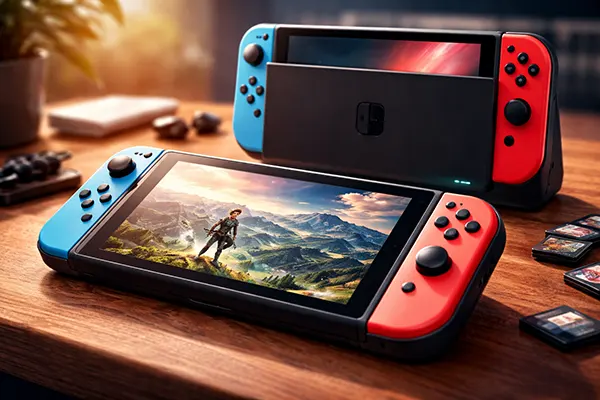
Nintendo Switch 2: What Has Actually Changed in the Hardware and Is It Worth Upgrading?
The original Nintendo Switch has remained relevant for nearly a decade thanks to its hybrid concept and strong game library. However, by 2026, expectations around performance, display quality, and system responsiveness have shifted significantly. With the arrival of the Nintendo Switch 2, the focus is no longer just on portability, but on whether the internal upgrades truly justify moving on from the original device. This article breaks down the real hardware changes and evaluates their practical impact.
Core Hardware Upgrades: CPU, GPU and Memory
The most noticeable improvement in the Switch 2 lies in its processing power. Nintendo has moved from the ageing Tegra X1 architecture to a newer custom NVIDIA chipset based on Ampere or a similar modern architecture. This results in a substantial increase in both CPU efficiency and GPU rendering capabilities. In practical terms, this allows for smoother frame rates, better physics calculations, and more complex environments in games.
Another key change is the introduction of DLSS (Deep Learning Super Sampling) support. This technology allows games to render at a lower internal resolution and upscale to higher resolutions with minimal loss in visual quality. For handheld gaming, this is particularly important as it balances performance with battery consumption while still delivering sharper visuals.
Memory has also been upgraded. Reports and early specifications suggest 12 GB of RAM, which is a major step up from the original 4 GB. This enables faster loading times, improved multitasking within the system interface, and better support for modern game engines that require more memory headroom.
What These Changes Mean in Real Gameplay
In real-world use, these upgrades translate into more stable performance across demanding titles. Games that previously struggled to maintain 30 FPS on the original Switch can now aim for 60 FPS, especially when optimised for the new hardware.
Loading times are noticeably reduced. Open-world titles benefit the most, with faster asset streaming and fewer interruptions when moving between areas. This creates a more consistent and fluid experience.
Developers also gain more flexibility. With increased power and memory, studios are less constrained by hardware limitations, which means ports from other consoles require fewer compromises in graphics and gameplay systems.
Display and Visual Improvements
The Switch 2 introduces a redesigned display, with strong indications pointing to an upgraded LCD panel with higher brightness and improved colour accuracy, or in some variants, an OLED evolution. The screen size has slightly increased, reducing bezels and improving immersion without significantly changing the overall device footprint.
Resolution in handheld mode has been improved, with support for 1080p output compared to the original 720p. This alone makes a visible difference in text clarity, UI sharpness, and fine details in games.
Docked mode also sees a meaningful upgrade. Thanks to DLSS and improved GPU capabilities, the console can output up to 4K when connected to a compatible display. While not all games will run natively at this resolution, upscaling provides a much cleaner image compared to the original Switch.
Impact on Visual Experience and User Comfort
The improved display reduces eye strain during longer sessions. Higher brightness and better contrast make it easier to play in different lighting conditions, including outdoors.
Sharper resolution enhances readability. Games with complex interfaces, such as strategy or RPG titles, benefit significantly from clearer text and icons.
Docked gameplay feels closer to modern console standards. While it may not match high-end systems, the gap is considerably smaller, making the Switch 2 a more viable primary gaming device for some users.
Battery Life, Storage and Build Changes
Battery efficiency has been refined rather than drastically increased. Despite more powerful hardware, optimisation ensures similar or slightly improved battery life compared to the previous generation. This is largely due to more efficient chip design and smarter power management.
Storage has been expanded significantly. The base model is expected to start at 256 GB, addressing one of the main limitations of the original Switch. With modern game sizes increasing, this change reduces the immediate need for external storage.
The build quality has also evolved. The new Joy-Con controllers feature improved durability, with efforts to address long-standing issues such as stick drift. The overall construction feels more solid, with better materials and tighter assembly.
Is It Worth Upgrading from the Original Switch?
If you primarily play older or less demanding titles, the upgrade may not feel essential. The original Switch still handles many games well, especially first-party releases designed with its limitations in mind.
However, for players interested in newer releases, third-party ports, or improved performance, the Switch 2 offers a clear advantage. The combination of better frame rates, faster loading, and higher resolution creates a noticeably more modern experience.
The decision ultimately depends on usage. For casual gaming, the original system remains sufficient. For those seeking improved performance, visual clarity, and longer-term compatibility with upcoming titles, upgrading becomes a logical step.
Similar articles
-
 Farlight 84 — Combat Dynamics an...
Farlight 84 has established itself as a distinctive …
-
Nintendo Switch 2: What Has Actu...
The original Nintendo Switch has remained relevant for …