
Titan Quest II — ARPG Rooted in Greek Mythology: Can It Become the Next Major Release?
The revival of Titan Quest in a modern setting has drawn considerable attention, particularly because the original title cultivated a loyal audience and maintained relevance for nearly two decades. Titan Quest II, announced and showcased throughout 2024–2025, is positioned as a full-scale continuation designed for contemporary hardware, with an emphasis on deeper systems, a refined combat model, and storytelling grounded in classical mythology. The project is being developed by Grimlore Games, known for its disciplined approach to action RPGs, and is currently scheduled for a 2025 release on PC and leading consoles. With expectations high, the question remains: does Titan Quest II have the potential to stand out in a genre dominated by long-established franchises?
Gameplay Direction and Mechanical Evolution
The development team has focused on building a system that preserves the identity of the original game while eliminating outdated elements that no longer align with modern ARPG standards. One of the primary design goals has been to refine combat responsiveness, introducing more precise hit feedback and enhanced enemy behaviour. This includes improved positioning, more coordinated attacks from groups, and boss mechanics designed around tactical movement rather than static exchanges.
Early previews from 2024–2025 indicate that the mastery system remains central to character progression. Rather than introducing a completely new framework, Grimlore Games has opted for a polished version of dual-masteries, enabling players to combine two distinct skill lines. This allows for hundreds of hybrid builds, each supported by skill modifiers, passive enhancements, and gear-specific talent effects.
The introduction of dynamic environments adds another layer of complexity. Weather changes, destructible elements, and terrain variations influence combat outcomes. For example, certain enemies gain strength during storms aligned with their mythological origin, while fire-based attacks weaken under heavy rain. These adjustments make battles less predictable and encourage strategic planning.
Combat Flow and Technical Improvements
Titan Quest II aims to deliver a smoother action experience, with reduced animation locks and more intuitive mobility. Dash mechanics, evasive rolls, and context-aware interactions were added to address the criticisms often directed at slower-paced ARPG titles. These updates allow players to reposition quickly during encounters, making timing and movement essential parts of the fighting style.
Artificial intelligence has received substantial attention. Enemy groups behave more cohesively, and elite units adapt to player patterns instead of remaining passive targets. This means that defensive skills, temporary buffs, and debuffs become essential components of survival rather than optional tools.
On the technical side, the game employs modern rendering technologies designed to maintain consistent performance across varied hardware configurations. The developers have stated that their main goal is stability: Titan Quest II should run smoothly at launch without requiring months of patches. This commitment is notable given the challenging history of large ARPG releases in recent years.
Worldbuilding and Mythological Foundations
The narrative direction centres on Greek mythology, though the game avoids the clichés commonly used in modern interpretations. Instead of focusing on simplified mythic tropes, the team chose to explore less familiar stories. This includes deities and legendary figures who rarely appear in popular media but hold significant roles in ancient texts. Their portrayal relies on historical references combined with creative reinterpretation to support engaging storytelling.
The world map is divided into interconnected regions, each built with a consistent cultural and geographical foundation. Players will navigate rural landscapes, sacred sites, coastal settlements, and mountainous territories shaped by ancient Greek architecture. These locations contain numerous side routes, narrative threads, and optional events that contribute to character progression without forcing repetitive tasks.
The antagonist in Titan Quest II is Circe, presented not as a traditional villain but as a complex figure whose motives evolve throughout the storyline. Her influence manifests through corrupted wildlife, magically altered soldiers, and environmental distortions. This approach aligns with the developers’ desire to create morally layered conflicts instead of simple good-versus-evil dynamics.
Environmental Storytelling and Exploration
Exploration plays a substantial role, with the environment designed to communicate narrative details visually. Ancient ruins contain carvings, fragments of pottery, and remains of rituals that reveal historical events. Players who observe these elements closely gain a deeper understanding of the setting and the timeline shaping the game’s events.
Secrets and optional areas are integrated naturally rather than hidden behind obscure mechanics. These include mini-dungeons, shrines offering temporary boons, and lost passages leading to rare equipment or lore fragments. This structure encourages thorough navigation of the map without forcing excessive backtracking.
Non-player characters are crafted with individual motives and nuanced backstories. Their dialogues include references to cultural traditions, regional conflicts, and personal struggles, contributing to an atmosphere that feels consistent with the ancient Greek world. These interactions help maintain immersion while supporting the overall plot.
Progression, Equipment and Economy
Character development in Titan Quest II revolves around the dual-masteries system, but equipment variety forms an equally important component. Weapons, armour, and accessories come in several tiers, each with specific bonuses linked to mythological concepts. Legendary sets, for example, reference heroes such as Heracles or Atalanta, granting unique benefits aligned with their historical feats.
The crafting system benefits from a significant upgrade compared to the original game. Materials gathered throughout the world can be combined to produce enhancements, improve item stats, or modify abilities. This provides more control over build progression, allowing players to adapt to new challenges without relying purely on random drops.
The in-game economy has been adjusted to prevent inflation and ensure meaningful decision-making. Merchants offer fewer but more valuable items, while trading with specialised craftsmen introduces unique upgrade paths. These revisions aim to eliminate redundant purchases and maintain balance across all stages of the campaign.
Endgame Potential and Long-Term Support
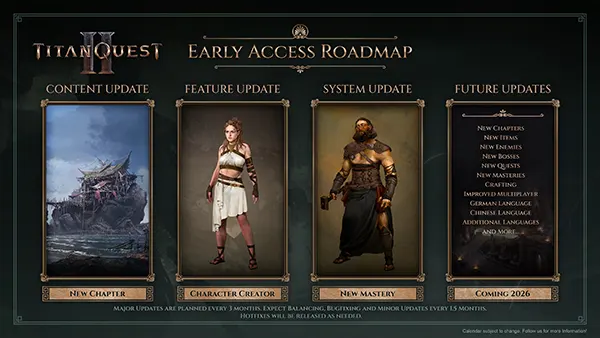
The developers have outlined plans for extended support beyond launch, including seasonal updates, challenge modes, and additional story content. While specific release timelines have not been finalised, Grimlore Games has expressed commitment to building a stable long-term ecosystem rather than releasing content in fragmented cycles.
Endgame activities will include advanced dungeons, elite encounters, and build-specific challenges designed to test player mastery. These scenarios emphasise skill synergy, tactical movement, and efficient use of cooldowns. Such design ensures that endgame activities remain relevant regardless of the player’s chosen playstyle.
Community feedback will play an important role in shaping updates. The team intends to monitor balance issues carefully and make adjustments without compromising the core identity of the game. This approach reflects an effort to maintain transparency and support a reliable environment for dedicated ARPG enthusiasts.
Similar articles
-
 Nintendo Switch 2: What Has Actu...
The original Nintendo Switch has remained relevant for …
-
 Free Fire: How to Play Aggressiv...
Playing aggressively in Free Fire can win you …