
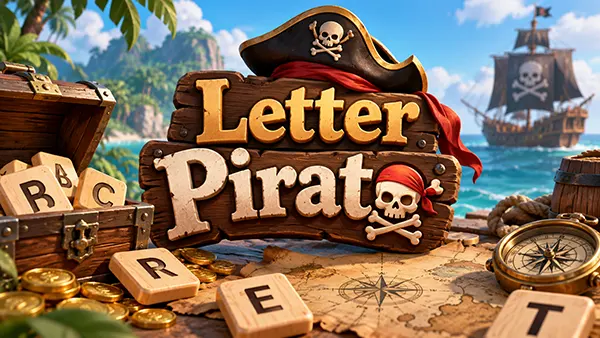
Letter Pirate: How Competitive Mechanics Change the Classic Word Puzzle on Mobile
Letter Pirate takes a familiar word-game idea and gives it a much more confrontational shape. Released by Ancient Bison LLC for iOS and Android in 2026, it is built around forming words, claiming letter tiles and taking territory away from another player rather than simply chasing a personal score. That change matters because every valid word can improve your own position while weakening someone else’s. The vocabulary challenge is still central, but it now sits beside timing, board awareness and the question of what opportunities a move leaves behind. The result is closer to a compact competitive board game than a conventional solitary word puzzle. Its rules remain easy to understand on a phone, yet the shared letters, tile ownership and turn-based structure give players reasons to think about the opponent as carefully as they think about spelling.
From Word Building to Territory Control
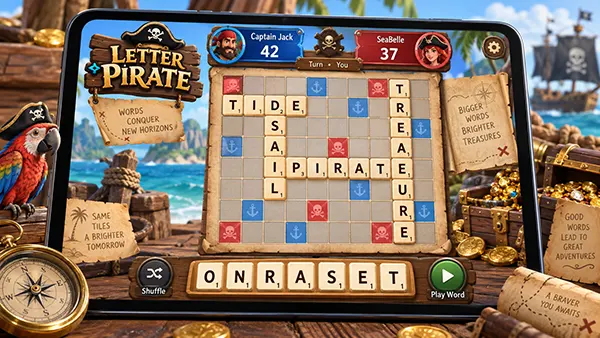
Most traditional word puzzles ask a player to solve a clue, build the highest-scoring word or use a set of letters as efficiently as possible. Letter Pirate changes the objective by connecting word creation to control of the board. Players take turns forming words, and the letters involved become part of the territory battle. Ancient Bison describes the winner as the player who controls the most tiles when the board has been filled. Each controlled tile is worth one point according to the developer’s support information, so the score is visible in the shape of the board itself rather than being detached from it. A strong move is therefore not only a linguistically good answer. It is a move that increases ownership, protects useful positions or creates a difficult reply for the other player.
The shared letter tray adds another layer without making the game difficult to read. Both players draw strategic value from the same pool of available letters, which means a useful vowel, a flexible consonant or an awkward character can matter to both sides at once. Leaving a convenient letter available may help an opponent build a better word on the next turn, while using a less obvious letter can sometimes reduce the quality of the reply they can make. The official game description even advises players to think about which letters they leave in the shared tray. This makes resource management part of the word puzzle, but in a very direct form: the player does not need to calculate complicated statistics, only to consider what the other person could realistically do with what remains.
That direct interaction is the main reason Letter Pirate feels different from a high-score word game. A word is never judged in isolation because its value depends on what it changes. A modest word can be useful if it secures vulnerable tiles or denies an obvious route, while a longer word may be risky if it leaves attractive letters or exposed territory behind. The board also gives each match a visible history. Earlier decisions remain present as owned tiles that can later become targets, so the player is constantly dealing with the consequences of previous turns. This produces a simple competitive loop: build a word, change the balance of territory, study the new board and prepare for the opponent’s attempt to reverse that advantage.
Why Stealing Tiles Changes Every Move
The defining rule is that an opponent can use letters you already control in a new word and take those tiles away from you. That single idea changes the emotional and strategic weight of a turn. In a conventional puzzle, a completed word is usually safe once it has been accepted. Here, the letters that helped you score can become material for the other player. A strong position can therefore be temporary, and ownership has to be defended through the shape of future possibilities rather than through a permanent lock. This is why the game rewards more than a large vocabulary. Players also need to recognise which of their tiles are easy to reuse, which letters are difficult to combine and where an opponent might be able to extend or redirect an existing word.
Ancient Bison explicitly presents awkward letters as a defensive tool, suggesting that players can wall off territory with letters that are harder to play. The idea is easy to understand even without studying formal strategy. If a valuable area is surrounded by letters that combine naturally with many common words, it may be easy to attack. If the available route requires an unusual spelling pattern, a less common combination or a letter that does not fit the shared tray, the same territory becomes harder to reclaim. This produces an interesting tension between immediate gain and future security. The best-looking word on the current turn is not always the move that creates the strongest board for the next two or three exchanges.
The stealing rule becomes especially important late in a match because large swings remain possible while useful connections are still available. The current store description notes that a long word near the end can overturn a lead, and that matches are designed around back-and-forth changes in ownership. That makes the final phase less predictable than a puzzle where an early score advantage simply accumulates. A player who is behind still has a reason to search for a move that crosses contested letters, while the leader has an incentive to reduce those routes and manage the shared tray carefully. The pressure comes from ordinary spelling decisions rather than from timers or complex combat rules, which helps the game keep the recognisable feel of a word puzzle even when the match is highly competitive.
Why Competitive Wordplay Fits Mobile Sessions
Letter Pirate’s turn structure suits mobile play because online matches are asynchronous. Players do not have to remain in the same live session while every move is made; they can take turns when they have time and return later after the opponent responds. That matters for a game in which a thoughtful word may be more satisfying than a rushed one. It also removes one of the common barriers to head-to-head mobile games: two people do not need to coordinate a long uninterrupted period simply to finish a match. The phone becomes a convenient place to check the new board state, consider the shared letters and make a move when there is enough time to think.
The developer’s support page lists several ways to start a game. Players can challenge someone by username, share a game link, meet a random opponent or play against computer-controlled bots. There is also a pass-and-play option for people sharing one device, and the listed bot settings range from Easy through Medium and Hard to Nightmare. These choices make the competitive mechanic useful in different situations. A friend match can become an ongoing exchange over several hours or days, a bot game can be used for practice, and pass-and-play can turn the same rules into a local two-person activity without requiring two phones. Online games require an internet connection, while the local pass-and-play mode is described by Ancient Bison as working offline.
This flexibility helps the game avoid relying on a single type of player. Some word-game fans want a relaxed puzzle they can return to occasionally, while others prefer the unpredictability of a human opponent. Letter Pirate can support both habits because the competition comes from the board and the turn sequence rather than from constant real-time pressure. The asynchronous format also gives the stealing mechanic room to work. When a player returns and sees that several previously controlled letters have changed hands, the board immediately presents a new problem to solve. That continuing state is well suited to short mobile check-ins because each turn has a clear before-and-after effect without requiring a lengthy explanation of what happened.
Simple Rules Create More Decisions Per Turn
Although the rule set is approachable, a single turn can involve several competing priorities. The player may want to form the longest available word, reclaim tiles that were just stolen, protect a vulnerable section, use a letter before the opponent gets it or leave behind a board that is awkward to attack. These goals can conflict. A move that captures many tiles might also connect several useful letters for the rival, while a smaller move might close an obvious route and preserve control for longer. This is the point where Letter Pirate moves beyond a simple vocabulary test. It asks the player to judge the quality of a word in context, and that context changes after every response.
Consider a simple situation in which two possible words use almost the same letters. One option takes more neutral tiles immediately, while the other crosses several letters currently owned by the opponent. The second word may be more valuable because it changes both scores at once: your territory grows while theirs shrinks. In another situation, using a highly flexible letter from the shared tray might improve the current move but leave the next player with an easy connection into your territory. These are not complicated calculations. They are ordinary trade-offs that can be read directly from the board, which is one reason the competitive layer works without turning the game into a dense strategy simulation.
The four bot difficulty settings also give players a practical way to learn these choices before relying on random matchmaking. Easier opponents can help a new player understand how ownership changes, while harder bots can punish loose letters and obvious openings more consistently. The 2026 update history also shows that Ancient Bison added animated hints for new players, which suggests an effort to reduce the initial learning barrier. At the same time, the game does not remove uncertainty. Human opponents may favour unusual words, defend territory differently or take risks that a predictable puzzle system would never choose. That variability gives repeat matches more value than a fixed set of word challenges where the same answer always produces the same result.
Letter Pirate in 2026: Features, Updates and Current Limits
As of September 2026, Letter Pirate is available on iOS and Android and is published by Ancient Bison LLC. Apple lists it in the Word category as a free download with optional in-app purchases, with a 13+ age rating and English as the listed language. The iOS version requires iOS 15.0 or later, while the developer states that supported Android devices need Google Play. These details matter because the game’s social features depend on account and network services when players compete online. The developer supports Apple sign-in, Google Play Games and email-based accounts, while guest play was added in a 2026 update to make it easier to begin without going through the full account process immediately.
The update record shows that the game changed quickly around its 2026 release period. An update made achievements available for stealing and other accomplishments, added a Wins leaderboard, introduced guest play and added animated hints. Later changes supported play in Europe and the UK, updated the dictionary and added the appropriate consent prompt for users covered by GDPR rules. The August update history also mentions visual improvements to selected and dropped tiles, clearer behaviour when unused tiles are left on the board, fixes for touch and tile-recall issues, and support for a Northern Lights event. These are not changes to the fundamental word-and-territory idea, but they show the developer refining usability and adding reasons to keep playing beyond a single head-to-head match.
The current iOS listing also includes optional token purchases and time-limited ad-free purchases. Those purchases are not required to play according to Ancient Bison’s support page, but the exact prices vary by country and can change over time. Cosmetic tile customisation and limited-time tile skins are part of the presentation, while achievements and the Wins leaderboard provide longer-term targets for competitive players. It is still a relatively young game, however, and Apple’s listing does not yet show enough ratings to provide a broad review summary in some regions. That makes it more sensible to judge Letter Pirate by its documented rules and available features than by assuming it already has the scale, content history or competitive community of much older mobile word games.
What Players Should Know Before Starting a Match
The clearest strengths come with equally clear practical limits. Online play needs a network connection, although pass-and-play can be used offline on one device. The iOS listing currently names English as the supported language, so players looking for built-in dictionaries in several languages should not assume they are available. Apple also lists a 13+ age rating and notes advertising, contests and user-generated content in its age-information section. The developer has not declared specific accessibility features in the current App Store entry, so people who depend on a particular accessibility option should check the latest store information before installing. None of these points changes the core game, but they are relevant when deciding whether its current 2026 version fits a particular player or household.
There is also a small but important inconsistency in the official information about board dimensions. The current App Store description says players battle on a 5×7 board, while Ancient Bison’s support page describes a 7×7 board. Both sources agree on the rules that matter most: players take turns forming words, letters become territory, owned tiles are worth points, the shared tray affects strategy and the player with the most controlled tiles wins. Because the two official sources disagree on the grid size, it is safer not to treat either dimension as universally definitive until the developer aligns its documentation. For players, the practical point is that the board is compact enough for territory to change hands repeatedly and for earlier words to remain relevant to later turns.
Letter Pirate is therefore best understood as a competitive reinterpretation of the mobile word puzzle rather than as another score-chasing vocabulary exercise. Its most effective idea is not the pirate theme or the cosmetic tile collection, but the rule that words can take ownership away from another player. That mechanic turns spelling into interaction: every useful letter can be an asset, a risk or an invitation to counterattack. The shared tray makes both players care about the same resources, asynchronous matches make the duel practical on a phone, and the scoring system keeps the objective visible on the board. For players who enjoy word formation but want more direct opposition and tactical consequences, that combination gives the familiar genre a noticeably different rhythm without making the rules hard to follow.
Similar articles
-
Letter Pirate: How Competitive M...
Letter Pirate takes a familiar word-game idea and …
-
 Xbox Mode in Windows 11: Can a G...
Windows 11 has moved noticeably closer to the …